Showing posts sorted by date for query o'neill. Sort by relevance Show all posts

Tuesday, May 26, 2020

Back to the Future


I want to return to my favorite topic, antibiotics, viewed through the lens of the covid-19 pandemic. Of course, as is probably true for all of us, my perspective is colored by my own history and experience. I want to share that with you before proceeding further. 

Back when I was working as a microbiologist and infectious diseases specialist at the VA Medical Center in Cleveland, the head of the pulmonary department asked me if I would attend (supervise) on our medical intensive care unit for one month a year. I thought this was because he admired my ability to diagnose infections combined with the fact that I also understood blood gas data. In retrospect, I wonder if it wasn’t that he couldn’t find anyone else to take the job. This was before there was a recognized specialty in critical care medicine in the US (boards were established in 1985). Luckily, I was supported by pulmonologists so that I had backup on decisions involving the proper use of mechanical ventilators among other issues. The work was . . . .intense. Often, on arriving in the morning, I could tell which patients had gotten into trouble the previous night by the number of antibiotic orders written for them. There seemed to be a correlation between the number of antibacterial, antifungal, and, for those truly desperate, antiviral drug prescriptions and the severity of their acute illness. I spent a great deal of time trying to hone the diagnosis of infection, if there was one, and, in the light of day, to “adjust” therapy to something more appropriate. 

The US CDC estimates that about 50% of hospitalized patients receive at least one antibiotic during their hospital stay. A study from New York hospitals treating seriously ill covid-19 patients showed that 89% received antibiotics. A recent review showed that about 8% of patients hospitalized with covid-19 infections had a complicating bacterial or fungal infection during their hospital stay, but that a striking 72% of all hospitalized covid-19 patients received antibacterial or antifungal therapy.  This reminded me of my own ICU experience. Given the numbers of such patients overwhelming our hospitals, this could represent up to a 50% increase in hospital antimicrobial use.

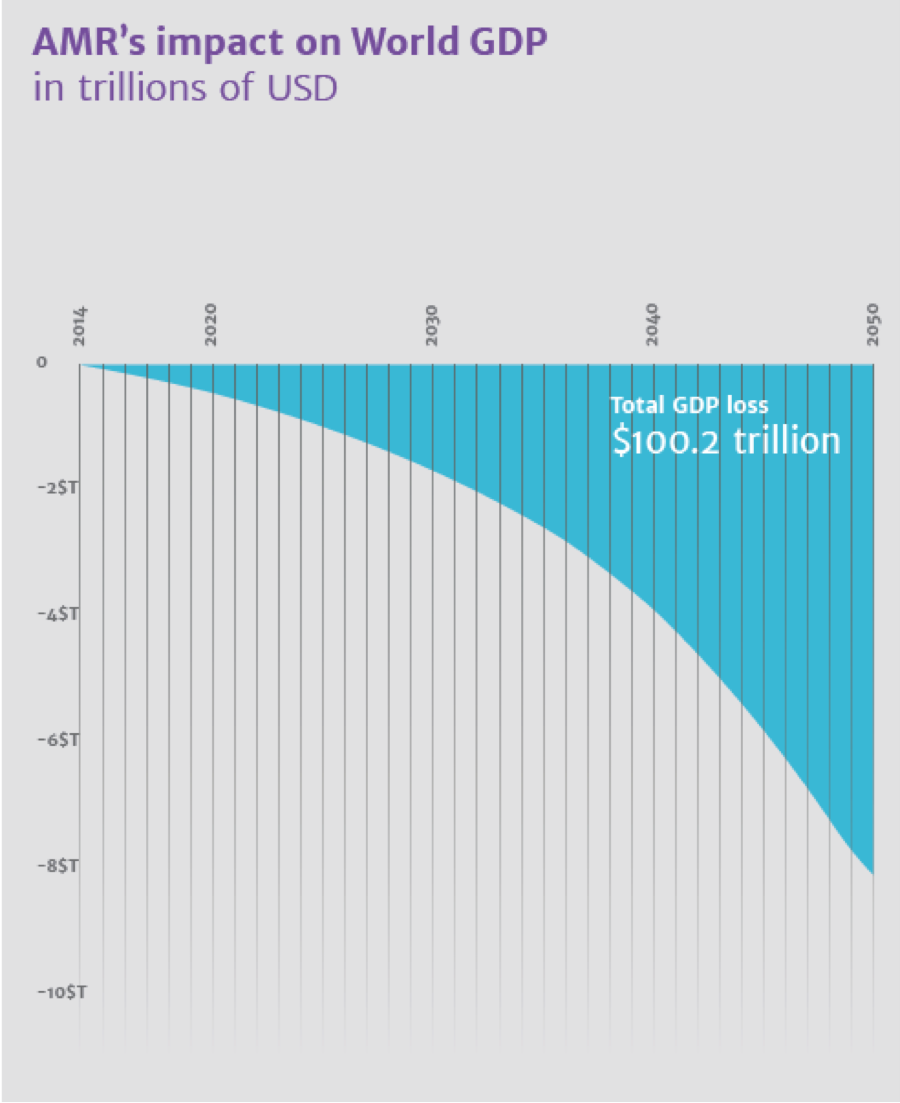
One thing that we know for sure is that the “you use it, you lose it” law of antimicrobial resistance rules. This means that the use of antibiotics, whether appropriate or not, will select for the emergence of resistant pathogens. Therefore, we can expect an increase in bacterial resistance in our hospitals – globally. The CDC recently reported that there about 3 million antibiotic resistant infections occurred every year in the US resulting in 48,000 deaths. Several years ago, the Review on Antimicrobial Resistance (I call it the O’Neill Commission since it was led by Jim O’Neill ex of Goldman-Sachs) estimated that there were 700,000 deaths worldwide annually due to resistant infections.  They predicted that given the trajectory of resistance, by 2050, 10 million lives will be at risk annually along with a $100 trillion-dollar loss to world GDP. No one imagined, I guess, that this might be accelerated by a global pandemic – but here we are. 

This unexpected acceleration of resistance will occur at a time when our 95% of our completely inadequate new antibiotic pipeline is supported by small and fragile biotechs. Will it occur during a time when we have learned at least one key lesson from covid-19 – to invest in our future health? Will we finally realize that we have to support the antibiotic marketplace to prevent further bankruptcies of antibiotic biotechs?  Will we find a way to encourage investment in our antibiotic pipeline again? Or will we ignore the counsel of untold experts and just wait for the next disaster to strike?

Monday, May 27, 2019

Antibiotic Research and Development - Public vs. Private Funding

Over the past decade, pull incentives as a solution to the broken antibiotic market have been proposed to entice companies into antibiotic research and development.  These incentives would essentially provide a market, and therefore a return on investment for pharmaceutical companies. Almost all of today’s inadequate antibiotic pipeline is provided by biotech and small pharma.  All are threatened with loss of investor interest because of the failed marketplace and many are experiencing difficulty in raising funds either from public or private markets.  One alternative to providing money to the “evil” pharmaceutical industry via a substantial pull incentive is to create publicly funded non-profit organizations or public-private ventures that would essentially replace the industry in antibiotic research, development and commercialization. Two proponents of this approach are Lord Jim O’Neill (of the O’Neill Commission or Antimicrobial Resistance Review fame) and Ramanan Laxminarayan of the Center for Disease Dynamics, Economics and Policy and of GARDP. Both, clearly, are key thought leaders in the area. 

The proposal sounds great. Who wants to give the pharmaceutical industry money, after all? But I find myself scratching my head about this. How, precisely, would this work? I presume we’re talking about government funding for an antibiotic R&D organization. In the US, would this be the National Institute for Allergy and Infectious Disease?  They have a strong track record in vaccine and in antiviral research – but antibiotics – not so much. Commercialization of products - not at all. In the UK would this be the Medical Research Council?  In Europe would it be the European Commission?  None of these august bodies have the experience required to establish a successful antibiotic R&D organization (in my humble view). The Innovate Medicines Initiative, an EU-funded public-private venture, has had mixed success tackling small pieces of antibiotic R&D but has not delivered a product to market and was not designed for that purpose. Then are we talking about establishing an independent organization with government funding? Who would decide who would lead the group? (On the positive side, there are lots of available antibiotic researchers available for hire.) To whom would the organization be accountable?

In addition to the questions posed above, we should all recognize the precedent this approach could set. Just think.  We could solve the entire pharmaceutical pricing problem with publicly funded R&D efforts – not just for antibiotics, but for all therapeutic areas. We could eliminate the evil pharmaceutical industry altogether.  Do we want to go there?

My experience suggests that it would take several (2-3) years just to get something established on paper and then bring it online.  Then we can count on about 5-10 more years to identify antibacterial lead compounds and then 10-15 more years to get something through clinical trials and to the market. So . . . maybe 20 years with some luck. During all these years, funding requirements would escalate enormously.  As more early leads are identified, it will take more scientists to move all of them to some go-no-go decision point. As more preclinical leads come online, the costs increase further. Finally, clinical development costs will become predominant – phase 3 trials are not cheap. The advantage of this program is that, at the beginning, the costs are relatively low - $10s of millions. But by the end, we’re in the $100s of millions per year assuming multiple clinical development projects. 

As an example, Achaogen, a small biotech in California, invested over $400 million in public and private funds to get plazomicin to the market and to carry out discovery and development programs for other lead compounds.  The company started in 2002 and plazomicin was approved in 2018. It earned about $1 million during its initial launch leading to its bankruptcy. A larger organization with multiple lead compounds, which is what we will need, will be much more expensive. 

While I’m not against establishing a publicly funded or public-private non-profit antibiotic R&D organization, I need to have a much better understanding as to how it would be established and what the funding needs would be. And I am very skeptical that government is willing, interested or even capable of carrying out this task. 

I believe that the two approaches, pull incentives for the existing industry and establishing a publicly funded non-profit, are not mutually exclusive. We could consider doing both – but we have to do it right! Pull incentives need to be substantial so that they actually work to replace the broken antibiotic market. A publicly funded entity must have the right leadership, the right accountability and adequate funding. Then, over time, perhaps the publicly funded entity could replace the industry in antibiotic R&D – if that’s what we really want. But again, color me skeptical in the extreme. 

(Email queries to the AMR Review and to CDDEP went unanswered).


Monday, February 11, 2019

Antibiotics - Play or Pay?

In my last blog I discussed the potential pull incentive proposed in the UK Plan to tackle antimicrobial resistance.  One of the other proposals in the plan was to implement a play or pay policy for companies actively engaged or not in antibiotic research and development. This idea was touted both by Jim O’Neill in the AMR Review and in his recent GARDP blog. I should point out that this is an old idea first proposed (as far as I know) by Dr. Lou Rice at an ICAAC meeting back in 2004.  The idea was not included in the 2004 white paper from the Infectious Diseases Society of America, Bad Bugs No Drugs (no longer available on the IDSA website).  Dr. Rice’s motivation was, in part, related to the marketing of antibiotics by industry that he felt may have helped to foster abuse and, ultimately, increasing resistance.   Play or pay was designed as an incentive for companies to engage or to continue to be engaged in antibiotic discovery and development and as a disincentive for disengagement. The proposal occurred at a time when many large pharmaceutical companies had abandoned the area. 

As is true for all of these attractive-sounding ideas, the devil is in the details. I have never understood exactly how such a policy could be implemented (but I’m happy to be enlightened).  

First, how do we define “company?”I assume that we are targeting large pharmaceutical companies to encourage them to re-engage in antibiotic R&D. I would define them as those with annual revenues of $10 billion or more. Allergan and Celgene would now be included in this group. But, one might ask, what about mid-cap companies like Regeneron, Valeant and others?  I am assuming that small companies would be exempt from play or pay.

Secondly, we must define “research” and “development” and decide if companies must carry out both activities to qualify. My view is that both preclinical and clinical research should be required. What domains must the research include?  Is a therapeutic vaccine effort sufficient? Is research on preventative vaccines or therapies OK? My own opinion is that vaccine research would be excluded from play or pay.  We need new therapeutics such as small molecules, peptides, proteins, antibodies and other similar approaches. Where does research end and development begin? Research could be defined as anything prior to, say, phase II clinical development. That way, phase I trials would be part of discovery research. If companies were allowed to just claim development activities for new therapies, Pfizer would qualify. But if pre-clinical research into new therapeutic approaches were required, Pfizer might not qualify. 

Third, how much should they play or pay?   Obviously, this incentive/disincentive has to be large enough that it works as such. One way to do this would be to require that 10% of a company’s total R&D budget be dedicated to antibacterial research and development. Many large pharmaceutical companies spend around $5-6 billion on R&D. Roche spent much more in 2017 (around $11 billion).  Therefore, the required spend on antibacterial R&D would be between $500 million and $1.1 billion in this scenario. The difference between their actual spend on antibacterial R&D and the 10% number would be the required payment. 

What would happen to any monies that came into the treasury based on this scheme?These funds could be used to support antibacterial research in academia and small companies and could be used to support significant pull incentives for new and needed antibiotics.

Where would the money come from?  Ahhhh! It is virtually certain that these costs would pass right back to consumers regardless of how any play or pay policy is implemented. And this takes us back to square one.  Do we want pharmaceutical consumers to pay or do we want to spread the payments for required antibacterial R&D and pull incentives among all taxpayers?  I vote for the latter.

Thursday, January 31, 2019

The UK Plan

The United Kingdom recently released a 5-year and a 20-year plan for combatting antimicrobial resistance.  These are both worth a careful read – especially if you are interested in efforts on stewardship and research support. (I sent several emails to colleagues within and outside the UK querying them on details on the UK plan, but have had no replies.  The workings of the UK team seem to be shrouded in secrecy.)

Buried in the forward to the 5-year plan is this –

We are leading the way in testing solutions that will address our global failure to incentivise the development of new antimicrobials and alternative treatments. We will test a new model that will de-link the payments made to companies from the volumes of antibiotics sold, basing the payment on a NICE led assessment of the value of the medicines and supporting good stewardship.

There is a great deal in that paragraph – most of which I find opaque. The idea of testing solutions to incentivize the development of new approaches to anti-infective therapies comes from the AMR Review headed by Lord O’Neill and recently reiterated in a blog post by him. The idea is to develop a global consortium to assemble the funding required for such a pull incentive. In their 5-year plan, the UK seems to be saying that they will “test” a model based on “value” of a new medicine to the health care of the nation. The first question is, how can one test an incentive that will surely not be an incentive since it will be unlikely to provide for global value to healthcare. The second question is, how will they determine “value.” And finally, where will the money come from?  If the money comes from an already underfunded NHS, how much money can this possibly be? 

What is “value” in this case?  Is it determined by things like decreased mortality, decreased length of hospital stay, decreased time of disability, increased quality life years,  . . . ? If it is any of these, how will that be determined since this is not usually a robust part of our modern non-inferiority trials that are used to approve antibacterial products? Would we then turn to historical data – either contemporary observational studies, NHS data mining or data from the preantibiotic era? We await further information from the UK in this regard. 

The UK population is around 66 million, the US is about 350 million and Europe is close to 500 million. Saying nothing about Asia and Africa, this makes the UK represent less than 8% of the population of the developed world. Let’s say, for argument’s sake, that the value of a new antibiotic on a global scale is on the order of $2 billion.  Would the UK share then be $160 million? Regardless of how this is calculated, the plan by the UK seems to assure that the pull incentive they alone would provide would not be enough to pull anyone anywhere.  

From a more positive perspective, perhaps their plan is to provide a method to determine value and come up for a number that would hypothetically be the UK share of some global incentive.  Then, their idea is to lead the world to a value based incentive where the cost would be shared among nations or regions. I think this is what they mean by “test.” 

This would be a valuable endeavor, but would probably not provide a significant pull incentive within 2019, which is the time frame many experts believe is critical to saving our antibacterial infrastructure and hence our pipeline of new products from oblivion. 

We all agree that an incentive that provides companies for a reasonable return on their investment in anti-infective therapeutics is an absolute requirement at this point. Such an incentive should, logically, to one extent or another, decrease the reliance of companies on price and sales volume and will thus also support good stewardship for these new products. Given the current urgency, I strongly believe that our default position for 2019 is to provide a market entry reward (prize if you like) to be awarded for the approval of a high priority antibiotic (as defined by CDC or WHO) on the basis of a contractual agreement with the company involved to guarantee access, manufacturing and distribution and to decide on pricing etc. Other approaches, such as the one being undertaken by the UK, will take too much time, but could inform the market entry reward at a later time. 

Monday, November 12, 2018

Antibiotic Awareness Week - Talk vs. Action?

This is antibiotic awareness week. To mark this week, there has been a great deal of talk and the publication of several important papers and workshops on antibiotics and resistance. At the same time, just after having achieved approval for their new antibiotic, plazomicin, Achaogen has downsized once again essentially jettisoning their R&D effort to focus on commercializing their new product. Why? Because they do not have enough money because investors do not believe their product will be very successful.  And why is that? Just look at the antibiotic marketplace. 

In the US, our National Academies of Sciences, Engineering and Medicine just published a report of their workshop, Understanding the Economics of Microbial Threats. The workshop was held by the Forum on Emerging Infections first established by Josh Lederberg and on which I was honored to serve for seven years. For those of you who have followed this topic or this blog, the workshop report offers little new in terms of the economics of antibiotics and antibiotic resistance.  It does provide an analysis by the workshop group of the National Academies, perhaps our most prestigious scientific body, which reports and supports what many have been saying for many years now.  The antibiotic market is broken and it will take government action on a global scale to fix it.  If we do not act, antibiotic resistance will continue to rise without a sufficient influx of new antibiotics to combat this threat. 

Specifically, the workshop report quotes a RAND study estimating the global cost of resistance by the year 2050 to be anywhere from $13-120 trillion dollars in reduced global GDP depending on various assumptions and discounting variables. This is similar to the $100 trillion dollar estimate from the O’Neill commission in the UK. 

The report acknowledges that pull incentives are essential to providing a means for companies to achieve a return on their R&D investment in new antibiotics. It notes that there is some debate as to which pull incentives would be best.  There seems to be an emerging consensus that pricing adjustments will not be successful (since they have not worked as yet). The preferred incentive may be a transferable exclusivity voucher – but the report does not provide details.  The report suggests that industry and government work together to better define what an appropriate pull incentive would be. My own view is that industry input is important, but must be taken at arm’s length. 


Around the same time the NAS report appeared, the European Centers for Disease Control published a report estimating the disease burden of antibiotic resistance in Europe.  They estimate that resistance is responsible for 33,000 deaths annually in Europe based on modeling.  This is not so different (given our population differences) with the 23,000 deaths in the US according to our CDC.  The ECDC paper also estimates the increase in disability-adjusted life years attributable to resistance showing very impressive increases associated with resistant infection. My own guess is that both US and European estimates are low. It is extremely difficult to gather reliable data in this regard simply because death certificates are rarely granular enough to provide insight into the importance of an antibiotic resistant infection in the demise of any given patient. So these estimates are all based on varying mathematical models. 

In the NAS workshop report, Ramanan Laxminarayan was quoted.  He “also pointed out that the way to think about AMR’s consequences on human health needs to go beyond only focusing on the death tolls from drug-resistant pathogens. He highlighted that AMR deeply affects care-seeking behaviors. He described a scenario in which an elderly patient might forgo a hip replacement surgery because of the higher associated risk of a postoperative infection and has to live with a bad hip for several more years. He reiterated that behavioral adaptations in response to not having access to effective antibiotics or any antibiotics at all are likely to be significant, and he urged the audience to think about these often overlooked ramifications.”

This provides much for us to consider during this antibiotic awareness week. My own takeaway from all this is – blah blah blah!! At this point, we need action. We need to invest in our future and that of our children now – not 10 years or 30 years from now. To those of you in responsible positions of government – you have no excuse to refrain from acting. This threat is too important for us to ignore. 

Wednesday, October 24, 2018

The UK and Antibiotic Resistance - What Happened?

 In 2016 I wrote a series of blogs on the many ways the United Kingdom was leading the fight against antibiotic resistance.  Tamar Ghosh blogged about the Longitude Prize for a new rapid diagnostic for resistant infections. I wrote two (1,2) blogs speculating on the effect of Brexit on the UK’s fight against resistance and comparing efforts in the UK to those in the US in this regard. A key personality in the UK’s approach to resistance was David Cameron.  He was supported by George Osborne, his Chancellor of the Exchequer, and Dame Sally Davies, his Chief Medical Officer. Cameron made antibiotics and resistance a top priority of his government. Antimicrobial Stewardship became a high priority within the National Health Service and used financial incentives and disincentives to achieve goals. 

So, what has happened under Teresa May? First, antibiotic resistance is no longer among the “top five” priorities in her government’s strategy – where it was in that list under Cameron. With Brexit looming, the European Medicines Agency (Europe’s pharmaceutical regulatory agency) decamped from London and opened up shop in Amsterdam. In the UK you hear very little these days about action and funding to deal with resistance. Brexit dominates the news cycle. (Of course, in the US, one might say that things are even worse than in the UK).

While there was progress in the area of stewardship, many of the other recommendations from the O’Neill Commission (as I call it), have not seen any progress.  Specifically, those recommendations dealing with the broken antibiotic marketplace have fallen by the wayside. A recent report from the UK parliament highlighted these shortcomings of the May government. According to CIDRAP, the report makes a number of key observations and recommendations.

·     In spite of lowering antibiotic usage by a relatively small percentage, there has been an increase in resistance among bloodstream infections in the UK.
·     40% of all antibiotic use in the UK remains in animals. The report recommends that this be further curtailed.
·     The report targets environmental discharge of antibiotics and other waste that might provoke or disseminate resistance.
·     Finally, and of greatest importance, the report notes that there has been a complete failure to follow the O’Neill Commission recommendations on fixing the broken antibiotics marketplace.  They parliament suggests a six month time period for government and industry to get together and provide specific recommendations for dealing with this problem. In other words, find a pull incentive that will work and then implement it! (Seeing is believing).

I don’t live in the UK and don’t spend enough time there to judge for myself whether there is any chance that this parliamentary report will result in concrete action.  (If this occurred in the US, I know exactly what would happen . . . ). But I do remember the days of the O’Neill Commission, the days when Dame Sally Davies was frequently covered by the world press as she spoke about the dangers of resistance and when antimicrobial stewardship policies in the UK grew teeth. Are those days gone?

One bright light in this story in the UK has been and continues to be the Wellcome Trust. The Trust clearly understands the importance of the resistance threat and it reacts by providing funding for a large variety of efforts to combat this threat. They do this alone and through collaborations here in the US, in China and throughout the world. But without key government action (think pull incentives), the Wellcome, even with all its collaborations, will not be able to finally deal with the threat of antibiotic resistance that is knocking at our door. 


Wednesday, June 6, 2018

Urgent - Time to Act!

For those of you who have not been following this story closely, the market entry rewards we have been discussing that are intended to fix the broken antibiotics market are not currently part of the Pandemic and All-Hazards Preparedness Reauthorization Act.  This legislation was our best hope of getting something in the budget. I have it on good authority that we should write the following congressional representatives in this regard. 

Rep. Doris Matsui (D-CA) megan.herber@mail.house.gov
Rep. Anna Eshoo (D-CA) rachel.fybel@mail.house.gov
Rep. Brett Guthrie (R-KY) sophie.trainor@mail.house.gov
Rep. Chris Collins (R-NY) charlotte.pineda@mail.house.gov
Rep. Marsha Blackburn (R-TN) meghan.stringer@mail.house.gov

Some talking points for you are included below. 

The antibiotic market is broken. The problem, from the private market view, will not be addressed anytime soon.  

In the meantime, antibiotic resistance is not going away.  The CDC estimates that we lose 23,000 American lives every year and $20 billion in excess costs to the problem of resistance.  Most experts, myself included, believe this is a vast underestimate. The O’Neill commission in the UK estimates that globally we lose 700,000 lives a year today to resistance.  They noted that if current trends continue, we will see over 10 million deaths and one hundred trillion dollars in lost GDP globally by 2050.  Ultimately, we will end up in a world where simple surgery, cancer chemotherapy, wounds of war and routine medical treatment will become dangerous because of the lack of antibiotics available to treat common but resistant infections.

At the same time, investment in antibiotic research and development is at an all time low. Between 2000 and 2010 all but a few large pharmaceutical companies had jettisoned their antibiotic research efforts. In recent years, Astrazeneca, Sanofi, and J&J all followed suit. The Medicines Company and Allergan disinvested within the last year and more companies are likely to follow soon. This is mainly due to lack of market incentive to pursue antibiotic research. Private investors have heard this message and consequently private funding of biotech is in danger as well. 

Even though public funding of antibiotic research has increased, there is no way to bring any resulting products to market without the participation of the private markets. 

To solve this impasse, government must act. The GAIN act did not work because extending exclusivity on a non-profitable product is not an incentive. Some sort of market entry reward is required to fix the broken antibiotic marketplace and re-incentivize private investment in antibiotic research. Most experts estimate the cost of this to the US would be something like $20 billion over ten years.  The consequence of not acting is too horrible to contemplate. 

I am happy to discuss this with you or your staff at any time.  Other experts you can contact include Kevin Outterson, John Rex and David Shlaes. 


Monday, August 21, 2017

Pull Incentives - An Open Letter to my Legislators

Dear Readers – please copy this and share it with your own representatives.

Dear Senators Blumenthal and Murphy and Representative Courtney,

I am writing this letter with the express intent to goad you into doing more to prevent the emerging crisis of antibiotic resistance becoming an urgent public health catastrophe.  The most important problem preventing further progress towards ramping up our antibiotic pipeline is the broken marketplace for antibiotics. We have come to view these drugs as cheap and always available – almost like a right to cheap lifesaving medicine. We also like to take new antibiotics and reserve them for only those patients who absolutely need them in order to protect them from emerging resistance.  This is a good plan for the public health, but not so much for the marketplace. The antibiotic market no longer provides for even a reasonable return on investment in R&D for these lifesaving medicines. 

You may argue that the pharmaceutical companies make billions in profits every year and that they have an obligation to pay us back by continuing antibiotic R&D even though they won’t be able to make money in this area. But these companies are there to make a profit for their shareholders. They will follow the money.  There are exceptions. But in 1990, ALL of the large pharmaceutical companies had active antibiotic R&D programs. For those special companies who continue their efforts in antibiotic R&D, given the bleak market prospects, they could abandon their efforts at any time.  Some have even been discussing this possibility. Most companies abandoned the area years ago for a variety of reasons – but the lack of a viable marketplace was an important motivation.

Why can’t the NIH or academic centers take this on?  Because they do not have the resources – but more importantly, they do not have the expertise. It would take many years of investment and education to get our academic research centers ready to take on this task. And even then there are many roadblocks to success here.

Since you have all been involved in discussions around the regulatory changes needed to assure our pipeline of new antibiotics, I don’t need to explain the importance of the problem of antibiotic resistance and its potential threat to our aging population as well as our children and grandchildren. The GAIN Act that forced the FDA to put feasible antibiotic development pathways in place was an important step. The 21st Century Cures Act that established a pathway for antibiotics to be used in limited populations with high medical need was an even more important step and I applaud you for leading this effort.

I don’t need to point out that the O’Neill Commission (as I call it) predicted 10 million deaths worldwide from antimicrobial resistance (including TB and Malaria) by 2050 if current trends continue. The cost to society globally could be as high as $100 trillion in lost GDP.


In this crisis the US, including the state of Connecticut is not spared. Nationally, the rate of highly resistant infections like those caused by highly resistant Gram-negatives called CRE has been rising as shown in the following data collected by Achaogen.

The New England area is not spared as shown in this map.

While antimicrobial stewardship and reduction of the use of antibiotics in agriculture and animal husbandry will help, even appropriate use of antibiotics will continue to select for resistance.  It’s the inevitable result of the formula – “you use it, you lose it” for antibiotics.

Improved regulatory pathways such as those already in place and those being developed by FDA will not be the entire answer either. Why?  Because the marketplace for antibiotics is broken.  Only government can fix this problem.  Without a healthy market, companies, where antibiotic discovery and development expertise reside, will not invest.  They can’t make money here – especially when compared to areas like oncology. We have seen the result of this with the majority of large pharmaceutical companies having abandoned the area starting in 1999.

The push incentives from HHS, the Wellcome Trust and others have been very powerful in helping to fund antibiotic research and development.  But they still will not be enough.  Companies need to see a viable market at the end of their R&D road.

The fix, unfortunately, no matter how it is constructed, will involve spending taxpayer money.  The funds can come from all taxpayers, from consumers of all pharmaceuticals, or from consumers of certain drugs where generic entry might be delayed by a few months. The way this will work will depend on the approach that government chooses. 

Of course, the other way to fix the broken antibiotic market is to wait for the crisis to hit. A good example of this is the global pandemic of methicillin-resistant staphylococcal (MRSA) infection that hit starting around 1982.


 By the late 80s, pharmaceutical companies were increasing their research efforts to come up with new therapies for serious MRSA infections.  They did this because they thought they saw a market opportunity in the growing number of cases of these infections.  But it took a great deal of time for them to get something on the market. The only oral drug for the treatment of these infections, Zyvox, was approved in 1999. Cubicin, discovered in the late 80s or early 90s hit the market in 2003. How long do you want to wait for the industry to get a new therapy to market after the crisis has hit? Luckily, for MRSA we had at least one other efficacious antibiotic we could use.  But in the case of these highly resistant Gram-negative infections, our choices are limited and not very efficacious.  So how long do you want to wait?

The answer is to fix the market now – with government funding. How much would this cost?  The US share (assuming we share the burden with Europe) would probably be something like $1-2 billion per year over the next 10 years. Our share would decrease if China, Japan and other Asian nations would join us. This is a paltry amount of money compared to our national budget.

So what are you waiting for?  Are you waiting for you or one of your loved ones to encounter one of these deadly infections personally?  Are you waiting for a more politically palatable moment to act? Like you, I am not getting any younger.  And I have children and grandchildren I care about. I have worked in hospitals where I have had patients with bacterial infections for which I had little or nothing to offer. Physicians and their patients should never be put in that position. And now, you, not anyone else – but you – are tasked with fixing this. Delay just increases the risk of a situation that none of us wants to imagine.

I am ready, willing, and with a little help, able, to work with you and your staffs to construct legislation that would fix the antibiotic market. It can’t happen without you. Please help!

Sincerely,

David Shlaes

Stonington, CT

Wednesday, April 26, 2017

A Prize for New Antibiotics with Poison Pills.

Recently, Rep. Jan Schakowsky (D-IL) and other democrats introduced legislation aimed at controlling drug prices, and, for us, providing for a prize for the introduction of a new antibiotic to market that provides activity against resistant infections or other key lifesaving characteristics. It is great that someone in congress wants to address the market failure for antibiotics with a government funded pull incentive. We’ve all been waiting for this news for a long time. But – it looks like we’ll have to keep on waiting.  This bill is so full of poison pills that my only hope is that it never passes as is.


In Title III of the bill, the prize is defined as $2B to come from the 2018 budget and to be available for 10 years.  That fund is to provide for up to three prizes. Really? It would be enough for one prize, but not three. Therefore, the appropriation would have to be renewed after every award. Right.  Of course, the goals are a little vague. They include reduction of readmission, an improved diagnostic or better programs in antibiotic stewardship.  Where was the goal for a new antibiotic again?

The prize is to be doled out by the Director of NIH. Although the NIH has a small number of antibiotic experts in its ranks, it has been pretty much the opposite of an antibiotic R&D powerhouse for decades. Why should the NIH control the award?  Why not BARDA that has great experience in this area?

Then, the company has to set a “reasonable price” for the product (whatever that means) and must at the same time give up exclusivity.  How does that work? Obviously, if you no longer control the patent on the product and you are immediately beset by generics, there is no motivation to spend money on marketing or on anything else.  At that point, you’re in commodity mode where your greatest expense is manufacturing and distribution.  In addition, any marketing materials (why do you need those if you’ve given up exclusivity?) must be submitted to NIH, CDC and FDA before release.  That guarantees a delay of 10 years.


Then there is the usual request for study by the National Academies (again) on the utility of push and pull incentives to stimulate research and development and on de-linking costs from pricing.  There is no doubt that push and pull incentives could have an effect on pricing as has been clearly demonstrated in the detailed analysis in the O’Neill reports from the UK. I still question whether these mechanisms “should” have too great an effect on pricing since high prices help to control use and overuse is not a good thing.

I want to spend some time, again, on this idea of de-linking.  I think I may be alone among my colleagues in wanting to remove this jargon from our vocabulary. First, you don’t really remove cost considerations from pricing since you are paying for some of the research in your push incentives – so one way or another, we pay. Second, the term fails to take into account the important aspect of physician education that must occur with the introduction of any new antibiotic to the market. Physicians have to understand the advantages and disadvantages of any such product, its appropriate use, when it should not be used, and how to make these critical decisions.  So far, this has been driven substantially by the company marketing the product, and involved collaboration with physician thought leaders, pharmacists and others in the health care system.  If the company did not fund these activities, who would? Has anyone thought about where this activity would come from?


It is very disturbing, frustrating and demoralizing (but not surprising) to see such an important idea, pull incentives to stimulate antibiotic research and development, receive such a bludgeoning at the hands of the political party that should know better.